
Palm Beach’s 2025 drought was the 6th driest year in over 130 years of records, with nearly 10 inches below normal rainfall. The winter did not bring relief, as extreme drought conditions are still worsening across Palm Beach County. If you’re seeing brown patches in your lawn, wilting plants, and struggling palms, your landscape is under serious drought stress, and it needs your help right now.
With conditions this severe and no relief in the forecast, waiting for rain isn’t the best plan. The good news is that with the right approach, you can keep your trees and plants alive through the worst of it.
Key Takeaways
- Drought stress shows up in visible signs, like wilting leaves, branch dieback, and premature leaf drop, but the most serious damage happens underground, where fine root hairs die and structural integrity weakens.
- Trees need 10-15 gallons of water per week per inch of trunk diameter, delivered slowly and deeply at the root zone (not at the trunk) to reach surviving roots in Palm Beach’s fast-draining sandy soil.
- Protecting stressed trees requires months of consistent care, not quick fixes; trees can continue declining for 12-18 months under prolonged drought conditions.
- While trees are under drought stress, avoid pruning (except for dangerous branches) and fertilizing, as both force stressed trees to expend energy they need for survival.
- Even occasional rainfall doesn’t end drought stress; your trees still need consistent deep watering to survive until sustained moisture returns.
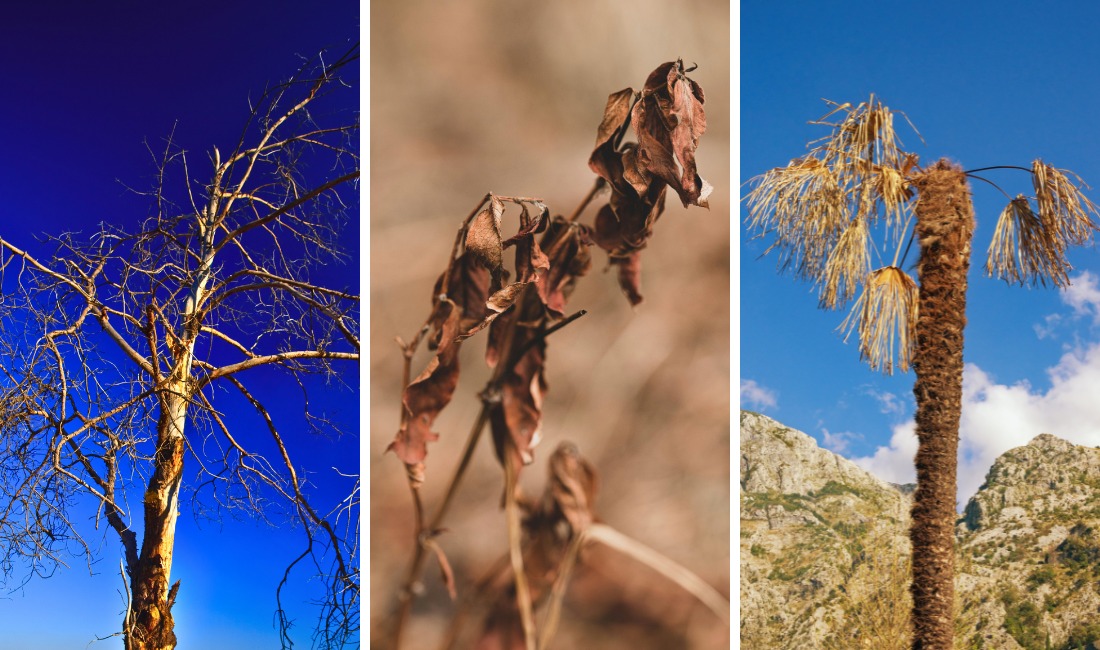
Drought stress appears differently across tree species, from complete branch dieback to leaf scorch and frond browning.
How Do You Know If Your Trees Are Under Drought Stress?
Drought stress shows up in visible symptoms you can spot during a walk around your property, though the most serious damage often happens underground, where you can’t see it.
Leaf and Foliage Problems
- Wilting (leaves drooping even in cool morning hours)
- Leaf scorch (browning from tips moving inward, not from edges)
- Yellowing leaves appearing across the entire tree
- Premature leaf drop during the growing season
- New leaves smaller than normal
Branch and Canopy Issues
- Branch dieback (dead twigs and branches, often starting at the top)
- Thinning canopy (you can see much more sky through the tree)
- Little to no new growth this season
- Early fall color
Palm-Specific Signs
- Excessive frond drop (more than normal seasonal drop)
- Fronds turning brown from the tips inward
- Spear leaf (newest frond) failing to open
- Trunk exposure from lost fronds
Whole Plant Problems
- Bark splitting or cracking
- Increased woodpecker activity (they find insects in stressed trees)
- Mushrooms or conks on trunk (indicate internal decay)
Hidden Damage You Can’t See
The most serious damage happens in the root zone, where you can’t see it. Drought kills the fine root hairs responsible for absorbing water and nutrients, and as those roots die back, your tree loses its ability to feed itself, even if there’s moisture nearby. That root loss also opens the door to root diseases and weakens the tree’s structural integrity, making it more dangerous during storms.
What makes this especially tricky is the timeline. A tree under prolonged drought stress can look perfectly fine above ground while slowly exhausting its stored energy reserves underground. By the time visible decline shows up (sometimes 12-18 months later), the damage is already severe. That’s why acting now matters, even if your trees look like they are doing okay in the drought conditions.
What Should You Do to Protect Trees During Drought Stress?
Protecting your landscape during an extended drought requires consistent, targeted care, not a one-time effort. These four steps will help keep your trees alive through Palm Beach’s ongoing dry conditions.
1. Water Deeply and Slowly at the Root Zone
When your trees are under drought stress, how you water matters more than almost anything else. As drought kills the feeder roots, it becomes more difficult for trees to absorb what moisture does exist in the soil. To make matters worse, Palm Beach’s sandy, limestone-based soil drains quickly and doesn’t retain moisture, so every drop needs to count.
Here’s how much water your plants need each week during drought stress:
- Trees: 10-15 gallons per inch of trunk diameter (measured at chest height, about 4.5 feet above ground).
- Shrubs: 2-3 gallons per foot of height.
- Mature Palms: 15-20 gallons.
If you’re working within water restrictions and limited watering windows, prioritize your most valuable plants first. Mature trees and established palms represent decades of growth and add significant value to your property, and they can’t be quickly replaced. Annual plantings and seasonal color can wait.
How to Water Your Landscape Properly
Water under the entire tree’s drip line (the area under the canopy) and ignore the trunk. Deliver water slowly with a soaker hose, drip irrigation, or a low-flow irrigation system. Drip systems and soaker hoses are particularly effective during drought because they deliver water directly to the root zone with far less evaporation than traditional spray heads.
The goal is to get water at least 12-18 inches deep. Water early in the morning when temperatures are cooler to reduce evaporation, and split the weekly amount into 2-3 sessions for better soil absorption rather than trying to deliver it all at once. To check if you’re watering enough, dig a small hole six inches deep and feel the soil; it should be moist at that depth. Always check between sessions to make sure you’re not overwatering and causing root rot.
Work Within Water Restrictions
Year-round Palm Beach restrictions limit automatic irrigation to odd addresses on Wednesday and Saturday, even addresses on Thursday and Sunday, with no watering during peak evaporation hours of 10 a.m. to 4 p.m. Using appropriate application methods can ensure you don’t waste your limited watering time.
PRO TIP: Upgrading your irrigation system to include smart controllers and drip irrigation zones can make consistent watering easier and more efficient, especially during extended droughts when every gallon matters. Smart controllers adjust run times based on weather data, so you’re not wasting water on days when conditions don’t call for it. Learn more about how irrigation systems work with Palm Beach’s water restrictions.
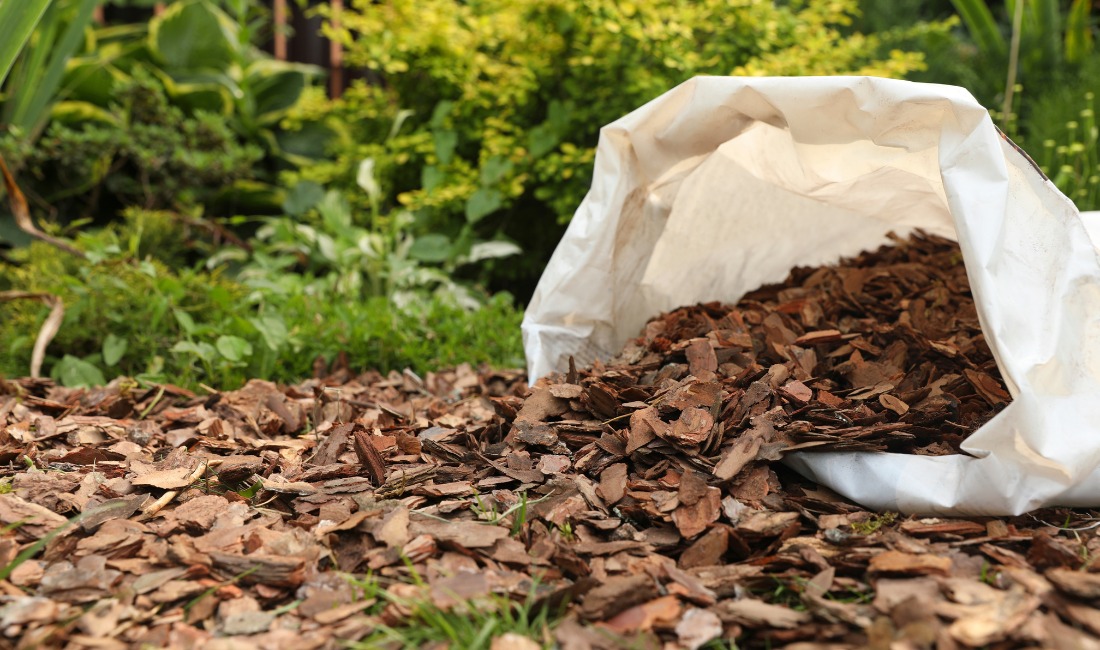
Applying 3-4 inches of organic mulch around trees helps retain soil moisture and reduces evaporation during extended drought.
2. Apply Mulch to Retain Soil Moisture
During an extended drought, mulch is one of your best tools for keeping soil moisture where your trees need it. Mulch keeps soil cooler and reduces evaporation by blocking direct sunlight from hitting the soil surface. It also suppresses weed growth, which removes a competitor for the limited moisture in the ground.
This matters especially in Palm Beach, where sandy, limestone-based soil drains fast and holds very little water on its own. Organic mulch, like wood chips, breaks down over time and gradually improves soil structure, increasing its ability to retain moisture with each season.
Apply 3-4 inches of organic mulch around the root zone, and keep it 3-6 inches away from trunks to prevent rot. Extend mulch out to at least the drip line for full coverage. Wood chips are a good choice because they break down slowly and don’t wash away as easily as finer materials in heavy rain.
3. Avoid Pruning and Fertilizing While Trees Are Stressed
Avoid pruning your trees while they are dealing with drought stress. Pruning forces trees to expend energy healing wounds and pushing new growth, energy they simply don’t have right now. The energy the tree uses to heal the pruning wounds would be better spent keeping its existing roots and branches alive.
The main exception is branches that are broken or hanging and pose a safety risk. A professional arborist can determine which branches need to come off during an inspection without removing more than necessary. Once consistent rainfall returns and your trees show new growth and improved leaf color, you can begin careful pruning and light fertilization. Until then, hold off.
Fertilizer is equally harmful during drought. It contains salts that burn already-damaged root systems and forces new growth when the tree needs to focus on survival. In severe cases, fertilizing during a drought can kill trees that would otherwise have pulled through. Wait until the drought breaks and trees have adequate moisture to process nutrients before applying any fertilizer.
4. Monitor Trees for Pests and Disease
Stressed trees attract borers, bark beetles, and other pests, while fungal diseases take hold quickly in weakened plants. Check the trunk and branches regularly for unusual holes, sawdust, or oozing sap. Look for mushrooms at the base, which indicate root or trunk rot. Early detection prevents problems from spreading, so if you see significant pest or disease issues, consult an ISA Certified Arborist.
Track how your trees respond over time by taking photos monthly to document improvement or decline. Note which plants are holding steady versus continuing to deteriorate. If a tree shows no improvement after 8-12 weeks of proper care, it may need professional assessment. Trees losing 50% or more of their canopy or showing structural problems should be evaluated by a professional for safety.
Why Isn’t Occasional Rainfall Enough to End Drought Stress?
A few rainstorms won’t undo months of extreme drought, and your trees’ stress doesn’t end just because it rained last week.
Trees burn through stored carbohydrates to survive drought, and rebuilding those energy reserves takes months of consistent moisture, not one or two storms. Dead roots can’t be quickly replaced, as new root growth is slow and requires steady water over weeks. Trees may look okay right now, but decline months later as they exhaust what little energy they have left. And weakened trees become targets for pests and diseases that pile on top of the original drought damage.
Frequently Asked Questions About Drought Stress
What’s the current drought outlook for Palm Beach?
As of March 2026, Palm Beach County remains under extreme drought conditions (D3 classification in much of the county) that forecasters are calling the worst drought in 25 years. The drought may continue into the spring until rains return to the area.
Do different trees handle drought better than others?
Yes. Native and well-established trees generally tolerate drought better than newly planted or non-native species. Palms and some hardwoods may handle dry conditions better, while others decline quickly without consistent moisture.
Can trees recover from drought stress?
Yes, many trees can recover if drought stress is addressed early with consistent deep watering and proper care. However, severe or prolonged drought can cause irreversible root loss, making recovery slower or unlikely.
What’s the single most important thing I can do to help my drought-stressed trees?
Water deeply and consistently. Aim to deliver 10-15 gallons per week per inch of trunk diameter, applied slowly at the root zone to moisten soil 12-18 inches deep. Use soaker hoses or drip irrigation rather than sprinklers, and divide the weekly amount into 2-3 sessions for better soil absorption.
Should I replace plants that are dying during the drought?
Hold off on replacing plants until the drought breaks. New plantings need extra irrigation to establish their root systems, which puts additional strain on your water budget during a time when every gallon should go toward keeping established plants alive. Focus your resources on protecting mature trees and palms, as they represent decades of growth and can’t be quickly replaced. Annuals and seasonal color can be replanted once consistent moisture returns.
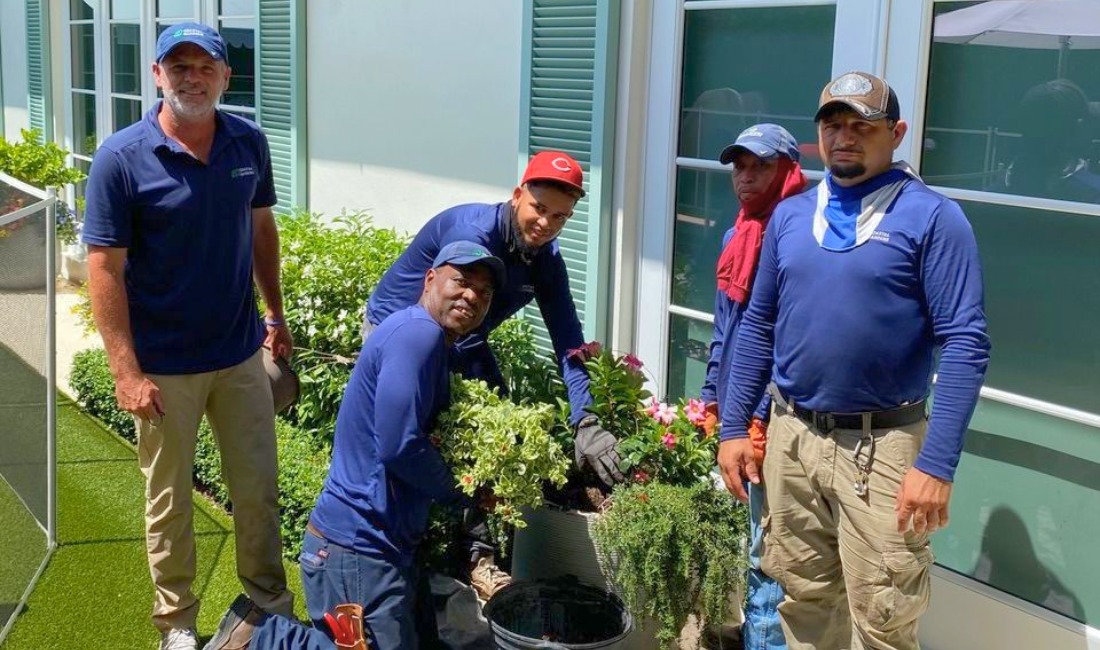
A professional landscape team can assess drought stress and help with irrigation adjustments, plant health monitoring, and prioritizing care across your property.
Get Expert Help Protecting Your Palm Beach Landscape
Palm Beach’s ongoing drought has stressed trees and plants across the area, and your landscape needs active protection right now, even when we get the occasional rainstorm. Deep, slow, consistent watering is the single most important thing you can do during drought stress. Aim for 10-15 gallons per week per inch of trunk diameter, delivered slowly at the root zone.
If your trees are struggling and you want a professional inspection or help with your irrigation strategy, the team at Coastal Gardens is here to help. We’ll help you keep your trees healthy and standing through this historic drought. Call us today at 561-308-7604 or schedule an appointment online for help with your drought-stressed landscape.
CALL US TODAY At 561-308-7604
Estate landscape Services
For Fine Properties in Palm Beach
With Coastal Gardens, you can rest easy knowing that your property is taken care of by a dedicated team of estate landscape professionals who truly care about creating and maintaining a dazzling outdoor space you can be proud of.
